Alexander III of Macedon commanded a fit, obedient army. He inherited respected and wise generals from his father, King Philip II, and all of Greek territory. Alexander conquered Persia, and spread and mixed cultures wherever he went. He founded many great cities and brought scholars on his journey across Persia to spread modern knowledge. He was charismatic, courageous, and handsome. These aspects led to him gaining the title of Alexander the Great, and why the majority of historians and the world consider him to be truly great. These reasons are why many great leaders such as Napoleon Bonaparte and Julius Caesar observed his achievements and copied his warfare tactics and ideas. However, there is a darker, less positive side of his actions. Burning cities, murdering thousands, and killing his own companions are but a few of the darker sides of Alexander III of Macedon. Renowned for his title, Alexander the Great is and has been the center of an argument that is centuries old, disputing whether or not he was truly great. Great, in this usage, implies true excellence as a leader. As a leader, Alexander the Great was more like Alexander the Average.

Ancient statue of Alexander the Great
Alexander III of Macedon often acted without forethought. Even with a tutor like Aristotle, and doing well in the arts in literature as he grew up, he often showed immaturity in his decisions. A prime example is reflected by the way he led the cavalry into every battle. While many historians and future leaders of great nations like Napoleon thought he showed great courage and dedication to his troops, there is another angle that should be investigated. With one well placed spear Macedonia’s new leader would have died, having dire consequences upon the whole of Macedonia. Since Alexander was the son of King Philip II, there was no doubt about him becoming the successor to the throne. Charging so riskfully into battle was extremely selfish, as he had no successor to calmly take over and protect his people. Due to the fact that he had no successors, in a case where Alexander dies, there would be a fight to become the new leader. On his deathbed, when Alexander was asked who the next leader would be, he calmly replied “To the strongest.” Library of History - Diodorus Siculus This is proved true when Alexander died of a disease in 323 BCE and Macedonia becomes the grounds of a civil war as Alexander’s main generals fight for control over the empire. Alexander’s lack of forethought could have led to serious conflicts and ultimately the downfall of Macedonia.
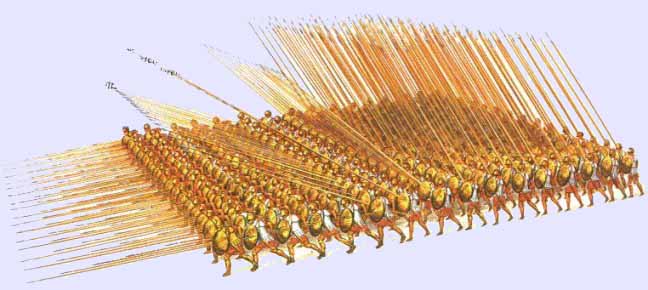
Another claim to Alexander's greatness is that he conquered all of Persia and defeated the great armies that denied him access to Persia. Persia was a land of riches, but no strong army. While Persia did have an army, they were not courageous, determined to win, or well organized. Their only goal was to protect Persia, and many would have rather stayed at home surrounded by jewels and gold, rather than train to fight in harsh, cruel conditions. Knowing this, King Darius III used the wealth of Persia to hire Greek mercenaries from different city-states to come fight for him. Many soldiers did not want to die for another country, so they ran with the money they had. What they lacked in numbers, Alexander's army gained in tactics and organization. Due to these measures, Alexander III of Macedon did not face an organized, determined, and powerful opponent. Alexander also used tactics created by his father, King Philip II, that were very successful as to taking over Greece and defeated northern Barbaric territories. The tactics were using a phalanx with 18 foot spears called sarisass to break enemy

A modern interpretation of the Phalanx accompanied with shields and sarissas
lines while the cavalry followed through to finish off the survivors. While Alexander charged recklessly with the cavalry, older generals from his army controlled tactics and adjusted to changes in enemy strategy. Plutarch observed Alexander’s behavior on the battlefield, claiming that “And since he was charging against hostile missiles and precipitous positions covered with infantry and cavalry, and through a stream that swept men off their feet and surged about them, he seemed to be acting like a frenzied and foolish commander rather than a wise one.” The Life of Alexander-Plutarch
While many leaders of powerful nations had an end goal, to beat a country, or to unite warring states, Alexander’s main goal was to kill King Darius the III of Persia. He wanted to spread knowledge, but he did not do so directly, as he allowed scholars to travel with the army and to distribute knowledge in cities they passed through. Alexander initially invaded Persia on the sole reasoning that King Darius III ancestors had burned multiple Greek cities. Alexander also turned down multiple offers from King Darius to become allies. Once again he acted without forethought, and charged across Persia to capture and killed King Darius. If he had accepted the offer, he would have saved thousands of lives, and there would have been more money to spend on advancing technology instead of destroying each other's cities and cultures. When King Darius was assassinated by Bessus, Alexander chased Bessus until he captured and killed him. Arrian of Nicomedia documented Alexander’s chase of Bessus observing “After being thus disgracefully tortured, he was sent away to Bactria to be put to death.” The Anabasis of Alexander - Arrian the Nicomedian Alexander wasted resources chasing two men across Asia, when he could have been expanding Macedonian territory, or helping fund advances in the arts and literature. Another example of recklessness and chaos is when Alexander destroyed and looted Persepolis. Persepolis was a beautiful city with grand architecture, and after Alexander had pushed through Persia to arrive at the city, he told his men to go into the houses, kill the people inside, and loot the location. A very immature and deadly decision, many soldiers died fighting against each other to gain control of the loot. When he reached the Royal Palace, after drinking and celebrating much, Alexander burned down the palace, destroying in hours which had taken years to build and was the pride of Persia.
While Alexander III of Macedon might seem a courageous, charismatic and handsome leader, he also possessed standard human frailties such as selfishness, cruelty, arrogance, and other common irresponsible character traits. The majority of the world believes that Alexander was truly great. However, due to his lack of forethought, immature decisions, and recklessness, Alexander the Great should be better known as Alexander the Average.
WORKS CITED
Emmons, Jim Tschen. "Alexander the Great." World History: Ancient and Medieval Eras. ABC-CLIO,
2004. Web. 21 Sept. 2016.
Arrian. "The Anabasis of Alexander." The Anabasis of Alexander. N.p., 27 Sept. 2014. Web.
25 Sept. 2016.
Siculus, Diodorus. "Book XVII (beginning)." LacusCurtius • Diodorus Siculus. Loeb Classical Library,
n.d. Web. 25 Sept. 2016.
Plutarch. "The Life of Alexander." Plutarch, The Parallel Lives. Loeb Classical Library, n.d. Web. 25
Sept. 2016
Howe, Timothy, E. Edward Garvin, and Graham Wrightson, eds. Greece, Macedon and Persia. Oxbow, 2015. Web.
Woodcock, By George. "Persia and Persepolis, Part II." History Today. History Today, May 1967. Web. 29
Sept. 2016.
Tronson, By Adrian. "The 'Life of Alexander' and West Africa." History Today. History Today, Jan. 1982. Web. 29 Sept. 2016.
Garland, Robert. "Greek Mercenaries." World History: Ancient and Medieval Eras, ABC-CLIO, 2016,
ancienthistory.abc-clio.com/Search/Display/1732807. Accessed 29 Sept. 2016.
Images
http://factfile.org/wp-content/uploads/2014/12/Alexander-the-Great-Statue.jpg