Alexander was a great leader with many unprecedented achievements, but that doesn't mean he deserves his title of "great". Marching his men to death and being an alcoholic are a few of the reasons Alexander does not deserve greatness. Greatness is something we all try to achieve. Whether or not you think others reached the goal of greatness is all a matter of opinion. Opinions are influenced by our culture, our worldviews, and our values. Mark Banschick M.D. says that someone is viewed as being great is just others envying them. Many people throughout the years have envied Alexander III and have strived to match his achievements, like recreate the same pose as the sculptor pictured below, including his successors and friends (Plutarch). Alexander was not a leader where he should have been, had horrible personality flaws, and his achievements were piggybacked off of his father.
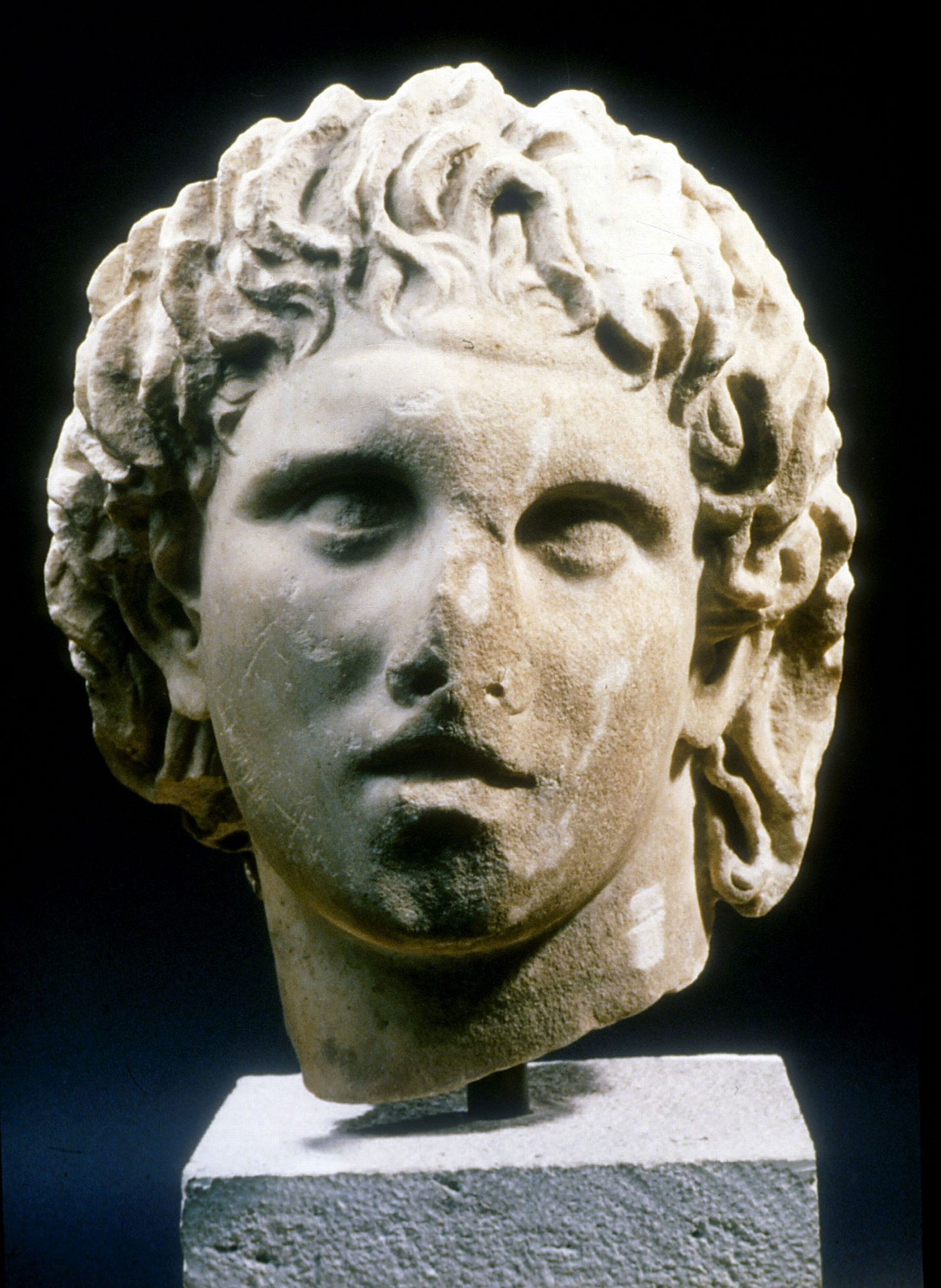 |
| https://ancienthistory.abc-clio.com/Search/Display/1444212?webSiteCode=SLN_HANC&returnToPage=%2fSearch%2fDisplay%2f1444212&token= 52D22D092D88E0AA41B3360DC729E1C9&casError=False Alexander's head sculpted out of marble. Many people tried to copy the position of his neck and the softness of his eyes (Plutarch). |
Alexander III was the king of Macedonia and Greece, the Pharaoh of Egypt and the conqueror of Persia. But were his priorities straight? After conquering Persia, instead of uniting his newly conquered land, Alexander moved eastward to hunt for Darius, the Persian king, not to benefit his kingdom. This made his man rebelled against him twice (Ian Worthington). Also he burned Persepolis, the royal capital of Persia to the ground, one of the new cities in his empire. The day of celebrating victory of conquering Persia, Ptolemy thought it would show Alexander’s achievements in Asia by burning down the palace. “These words were spoken to young men who were completely out of their minds because of drink,” (Diodorus Siculus). Young men, including Alexander, were drunk and were thinking about burning down the jewel of Persia. After setting fire to the city all that was left were ruins, and the columns of a once grand palace. A bon fire may have been fun to celebrate, but burning down a building is something that only powerful people, like Alexander, could get away with. He also got away with killing senior generals. For disagreeing with Alexander's views of blending cultures, he first executed Philotas and Parmenion. He also killed another senior general, Cletius, while drunk because Cletius applauded Philip II, Alexander’s father (Ian Worthington).
 |
| http://www.ancient.eu/article/214/ What was left standing, of the palace, after Alexander's burning of Persepolis. |
Alexander’s drunken decisions are countless, so did he ever make a sober one? Alexander was without a doubt an alcoholic. Arrian recorded based on the Royal Diaries “(Alexander) was drinking far into the night with some friends.” Arrian also suggested that his drinking problem ultimately lead to his death. While Alexander was alive he was very selfish. On a wild goose chase, after Darius, he made his men march for three years. There was no reason to go after Darius except for his stubbornness to not to let him escape. He found Darius dead after three years of searching. But, Alexander made his men continue to push on with little water and few breaks. For eleven years they marched, ultimately marching more than 11,000 miles. Alexander wanted to reach the other side of the continent, because he wanted his legacy to be greater than his father’s. Even though he would not have succeeded if his father did not lay the groundwork first (Ellen Bialo).
Alexander would not even be considered great if it weren’t for his education provided by his father, his father’s military, or his strive to measure up to his father. As a young boy Alexander was a student of Aristotle. “For my hope is that, under your education and instruction, he will be worthy both of us, and of the succession to the government of this empire,” (Philip). Philip recruited Aristotle to be Alexander’s tutor when Alexander was born. Without the tutoring of Aristotle, Alexander would not have made the same action that seemed to be influenced by the philosopher life (Russell M. Lawson). As a young king Alexander set out to do what his father was unable to do before he died, conquer Persia. But unlike his father he did not have to create a military. His father, as a young king, would take the peasants and turn them into a brawny force to be reckoned with. His strategies of phalanx (16 men by 16 men) would be the reason Alexander never lost a battle. All Alexander had to do was take command and make sure Greece was still organized under his control. Also throughout his whole life Alexander seemed to outrage at anyone putting his father above him. A senior general got killed because he honored Philip more than Alexander (Ian Worthington). Alexander would not have achieved so much if it weren’t for his father building him a foundation.
A person should not achieve greatness by being a mediocre leader, having a horrible character, and achieving everything because of you parents. The ancient would named him great after he died mostly because of Plutarch, who wrote a scroll exulting Alexander. But times have changed, culture, worldviews, and religion have been altered since BCE. Just like how two people cannot stand in the same place at once, the same two people will not have the exact opinion. Alexander was great in the eyes of ancient people, but now it's debated that he is not great. The facts have not changed since he died so the worldviews must have. The constant changing, maybe is causing them to get closer to what is really ‘great’, but maybe they are just be getting farther away from what true greatness is. Each person will have a different stance on the greatness of Alexander III, but do we even know what greatness really is.
"Alexander the Great." World History: Ancient and Medieval Eras, ABC-CLIO, 2016,
ancienthistory. abc-clio.com/Search/Display/1444212. Accessed 29 Sept. 2016.
Banschick, Mark. "Greatness Redefined." Psychology Today, Sussex, 5 Apr. 2013, ancienthistory. abc-clio.com/Search/Display/1444212. Accessed 29 Sept. 2016.
www.psychologytoday.com/blog/the-intelligent-divorce/201304/greatness-redefined.
Accessed 29 Sept. 2016.
Bialo, Ellen. "Career of Alexander the Great." World History: Ancient and Medieval
Eras, ABC-CLIO, 2016, ancienthistory.abc-clio.com/Search/Display/1185181.
Accessed 29 Sept. 2016.
"The Death of Alexander the Great, 323 BC" EyeWitness to History,
www.eyewitnesstohistory.com (2008).
Emmons, Jim Tschen. "Alexander the Great." World History: Ancient and Medieval Eras
ABC-CLIO, 2016, ancienthistory.abc-clio.com/Search/Display/575648. Accessed 29
Sept. 2016.
Sept. 2016.
Lawson, Russell M. "Aristotle." World History: Ancient and Medieval Eras, ABC-CLIO,
2016, ancienthistory.abc-clio.com/Search/Display/1451051. Accessed 29 Sept. 2016.
Mark, Joshua J. "Alexander the Great and the Burning of Persepolis." Ancient
History Encyclopedia, 23 Feb. 2011, www.ancient.eu/article/214/. Accessed
29 Sept. 2016.
"Philip II of Macedon: Letter to Aristotle on the Birth of Alexander (356 BCE)." World
History: Ancient and Medieval Eras, ABC-CLIO, 2016, ancienthistory.abc
clio.com/Search/Display/1813280. Accessed 29 Sept. 2016.
Plutarch. The Parallel Lives. 125 AD. University of Chicago, Bill Thayer,
penelope.uchicago.edu/Thayer/E/Roman/Texts/Plutarch/Lives/Alexander*/3.html.
Accessed 20 Sept. 2016.
Worthington, Ian. "Was Alexander Really Great?: a Great General Vs. a Great King ."
World History: Ancient and Medieval Eras, ABC-CLIO, 2016, ancienthistory.
abc-clio.com/Topics/Display/1525034?cid=13. Accessed 29 Sept. 2016.

I found you intro and conclusion really interesting because I liked how you mentioned that being great is not necessarily a good thing and how the modern view of greatness has changed. My blog post was pretty similar to yours but in Plutarch's Life of Alexander I actually found some negative information on Alexander. I wish you mentioned more on how Alexander destroyed cities that tried to resist him, like Gaza, Tyre and Thebes.
ReplyDeleteI found it interesting your point about how not everyone's opinion is not going to be the same and how people define greatness is different from the ancient to the modern world. My research was very different, as you said in your conclusion not everyone is going to have the same opinion but I think you made a strong argument. I wish you would have mentioned why people think he was great as well.
ReplyDeleteIan Krajna
ReplyDelete1. I thought it was interesting how you focused on the fact that a lot of his success was due to his father.
2. My research found that Alexander burned the Royal Palace at Persepolis, not the whole city.
3. I wished you talked more about how Alexander did not control his army in battle with his generals, but instead, recklessly charged off at the head of the cavalry.
I found it really interesting how in your introduction along with your conclusion, you mentioned how different people can have a different deffinition on calling someone "great". This was an aspect that I really enjoyed about your writing because it made me question my opinions as the reader. I also found it interesting how your writing did talk about some of Alexander's "bad" character traits, while in my reading and research was focused on his good and well liked character traits. I do wish that you did mention a little more on how Alexander inherited most of his power from his parents. I found this point very interesting and wanted to learn more.
ReplyDelete